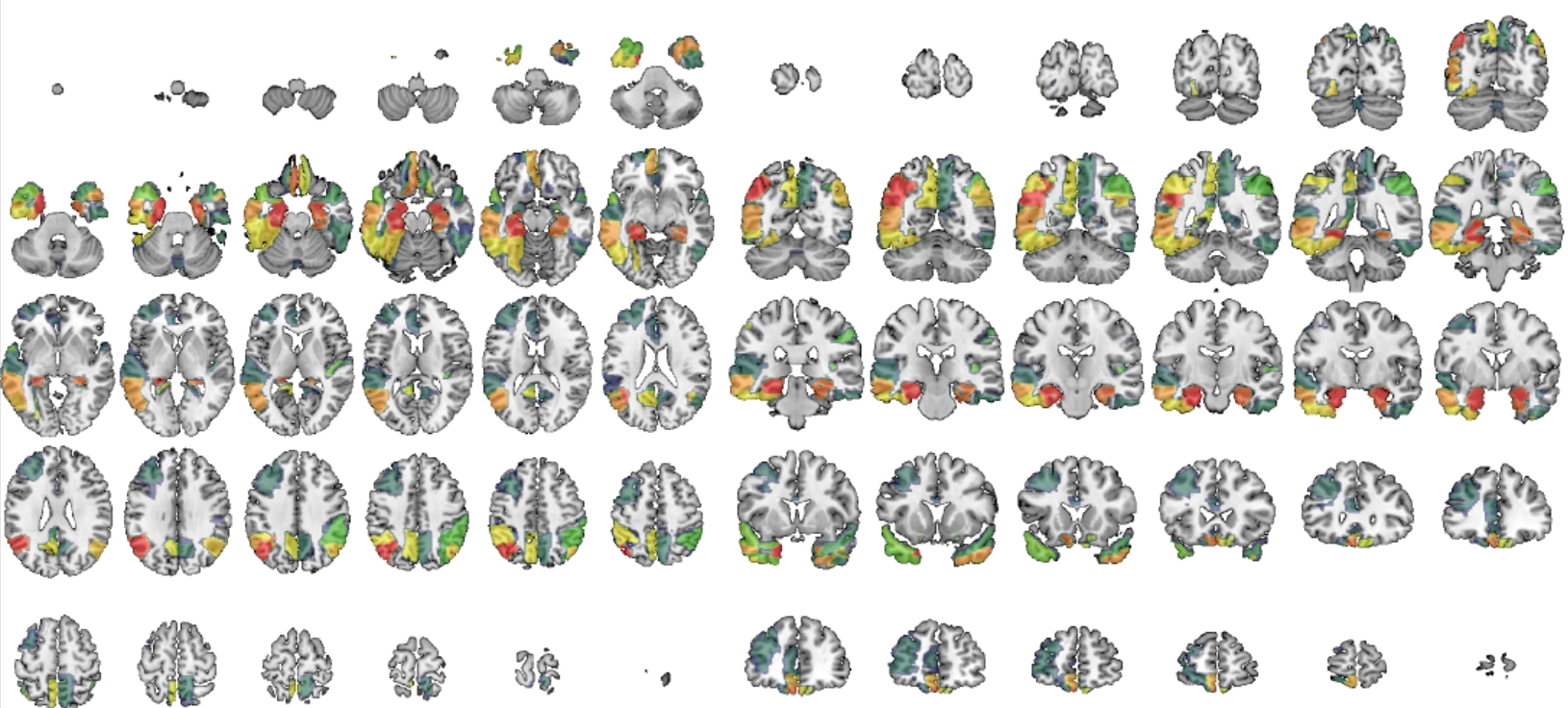
Nowadays, structural and functional imaging technologies in neuroscience are providing a large volume of information, where machine learning approaches are qualified to provide a new perspective on neurological pathologies, such as Alzheimer’s disease (AD). Novel computational and mathematical approaches, based on statistical learning theory, have been proposed for the development of computer-based diagnostic aid systems in the field of Alzheimer’s disease.
In particular, from the perspective of data analysis, the main results have been:
1. Classification Methods (see the article at https://www.ncbi.nlm.nih.gov/pubmed/27478060 ) based on deep learning architectures that are applied to brain regions defined by Automated Anatomical Labeling (AAL). Magnetic resonance grey/white material (G/WM) images obtained from each brain region were divided into 3D patches according to these AAL regions to train a set of deep belief networks. These complex networks allow classifying groups of controls and patients (AD) with a high accuracy by improving the reference methods.
2. Complex systems based on standardisation of characteristics, ANOV selectionA (see the article at https://www.ncbi.nlm.nih.gov/pubmed/29242123 ) or in transductive learning (see the article at https://ieeexplore.ieee.org/document/7945239 ), feature reduction based on partial least squares and random forest ensembles in multi-label one vs. all schemes allow reproducing the same results with the aim of obtaining also high discrimination of healthy controls and individuals with mild cognitive impairment, with secondary stages reconsidering the classifications between HC and MCI of the first level.
Finally, all these machine learning-based techniques have the potential to provide in-vivo assessment of functional/structural brain parameters in neurodegenerative diseases such as Alzheimer’s disease. Relevant links to these results can be found as software tools in:
- https://sipba.ugr.es/research/petra/
- http://sipba.ugr.es/research/spherical-brain-mapping/
- https://github.com/SiPBA/brainSimulator
Period
May 2007 – current
Researchers
Juan Manuel Górriz Sáez, Javier Ramírez Pérez de Inestrosa, Andrés Ortiz García, Fermín Segovia Román, Francisco J. Martínez Murcia, D. Salas González
Partners: Alzheimer Disease National Initiative (ADNI), The Dominantly Inherited Alzheimer Network (DIAN)