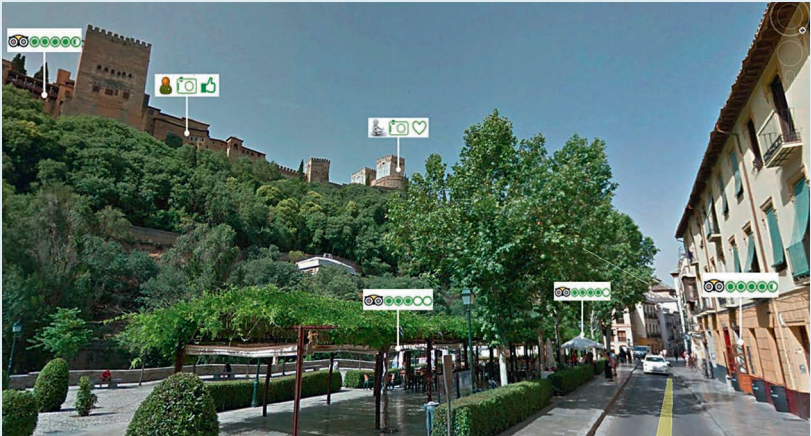
In the last decades the amount of social media data stored on Web 2.0 has grown exponentially. Because of this, both public and private organisations are interested in developing techniques to analyse the content of Web 2.0 sites in order to study their reputation or to know the opinion about a product, a hotel, a restaurant, a political party or a certain cultural monument.
Opinion analysis has emerged as a new tool for analysing Web 2.0 information. Its main objective is to systematically analyse people’s opinions about a product, organisation or event.
In this sense, work has focused on the opinions of the tourism and cultural industry. For this purpose, TripAdvisor, a Web 2.0 travel website, has been used as a source of data, which shows travellers’ opinions on hotels, restaurants or tourist attractions in thousands of cities around the world. For this type of institutions it is of vital importance to know the opinion of their visitors so that they can improve the quality of their experience. The results highlighted are:
- The viability of TripAdvisor as a source of reviews for cultural monuments is corroborated. The need to have a trusted source of data to develop our studies is crucial and of utmost relevance (see the article https://ieeexplore.ieee.org/stamp/stamp.jsp?arnumber=8012330).
- A methodology for opinion synthesis is proposed. An automatic summary of all negative opinions is made through deep learning and subgroup discovery. This can help the decision-making processes of these organisations by detecting in a clear way those aspects that need to be improved (see the article https://link.springer.com/article/10.1007/s12652-018-1150-3).
Period
January 2017 – Present
Researchers
Francisco Herrera, Ana Valdivia, Mª Victoria Luzón, Eugenio Martínez-Cámara.
Partners: Erik Cambria de Nanyang Technological University of Singapore.