The combination of data from six European hospitals and machine‑learning techniques enables the University of Granada to improve the identification of one of the most difficult‑to‑classify nontuberculous bacteria
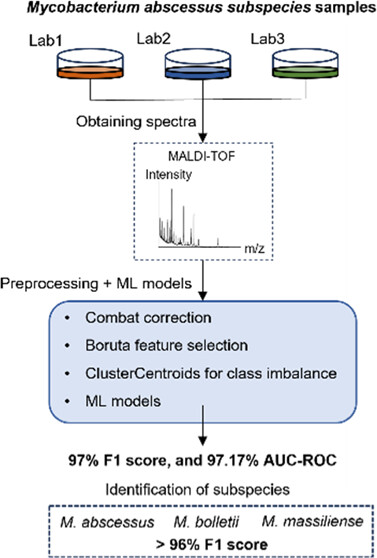
A team of researchers from the Department of Computer Science at the University of Granada and the DaSCI – Andalusian Research Institute in Data Science and Computational Intelligence, in collaboration with Clover Bioanalytical Software S.L. and the Gregorio Marañón General University Hospital, has developed a machine‑learning approach that significantly improves the identification of subspecies within the Mycobacterium abscessus complex using MALDI‑TOF MS spectra, a rapid and accurate technique for identifying microorganisms through protein patterns.
The study, recently published in Journal of Proteome Research, analyzes 325 spectral profiles obtained in a multicenter setting and shows that correcting inter‑laboratory variability, reducing spectral binning, and combining this processing with feature selection and class‑balancing techniques yields performance far superior to what has been reported to date. The best configuration achieved approximately 97% precision and recall in species and variant identification, and around 97% correct classification among subspecies in the test set.
One of the key technical elements of the work is the reduction of binning, a concept referring to the grouping of signals in the spectrum. This decision enhances the model’s ability to detect subtle differences between highly similar spectra and contributes to balanced results across subspecies, including notable improvements in identifying the most challenging variant to discriminate: M. abscessus subsp. bolletii.
The proposed method aims to increase model robustness in real‑world scenarios, where data come from different hospitals and exhibit inherent variability. Such robustness is essential for AI‑based tools to be reliably transferred into clinical practice. The work forms part of the doctoral thesis of Erica Fuillerat, a PhD student at DaSCI, and also includes the participation of Juan Emilio Martínez, second co‑author and doctoral student at the same institute. Additionally, the data used in the study are available on Zenodo, in line with open‑science and reproducibility principles.
The Andalusian Interuniversity Institute in Data Science and Computational Intelligence, known as the DaSCI Institute, is a collaborative entity involving the universities of Granada, Jaén, and Córdoba. It is dedicated to advanced research and training in the field of AI, with a particular focus on Data Science and Computational Intelligence. The institute brings together a distinguished group of researchers who work on joint projects, promoting the development and application of innovative technologies across multiple sectors. With the aim of becoming a leading reference in its field, DaSCI drives the transfer of scientific knowledge to the socioeconomic environment, thereby contributing to technological progress and the digitalization of industry.
Link to the publication:
- https://pubs.acs.org/doi/10.1021/acs.jproteome
- DOI: https://pubs.acs.org/doi/10.1021/acs.jproteome.5c00534
Access to the data used in the study, available on Zenodo:
https://zenodo.org/records/17937866
Contact:
Coral del Val – delval@ugr.es
This publication is part of the project “Ethical, Responsible and General Purpose Artificial Intelligence: Applications in Risk Scenarios. (IAFER) Exp.: TSI-100927-2023-1 funded through the creation of university-business chairs (Enia Chairs), intended for research and development of artificial intelligence, for its dissemination and training within the framework of the European Recovery, Transformation and Resilience Plan, funded by the European Union-Next Generation EU.