The tool, rigorous and with all ethical guarantees, is key to the protection of undocumented migrant children in border contexts.
A team of researchers from the Andalusian Interuniversity Institute of Data Science and Computational Intelligence (DaSCI) at the University of Granada, the University of Oviedo, the University of A Coruña, and the technology cooperative Panacea Cooperative Research has presented an artificial intelligence system that marks a turning point in estimating legal age from dental X-rays. The work, titled “Trustworthy AI-based legal age estimation using orthopantomographs” and published in the journal Applied Soft Computing, offers a precise, robust, and ethically designed tool to help determine whether a person is over or under 18 years of age, a critical process in the protection of undocumented migrant children.

The new method, called LAENet, was trained using the largest and most diverse collection of orthopantomograms to date. The dataset includes more than 10,700 X-rays from 16 countries and five continents, allowing the system to function reliably even when faced with individuals from very different geographical backgrounds. Furthermore, the researchers conducted external validation using nearly a thousand additional images from countries not included in the training, thus simulating real-world scenarios where a person’s origin is unknown or highly heterogeneous.
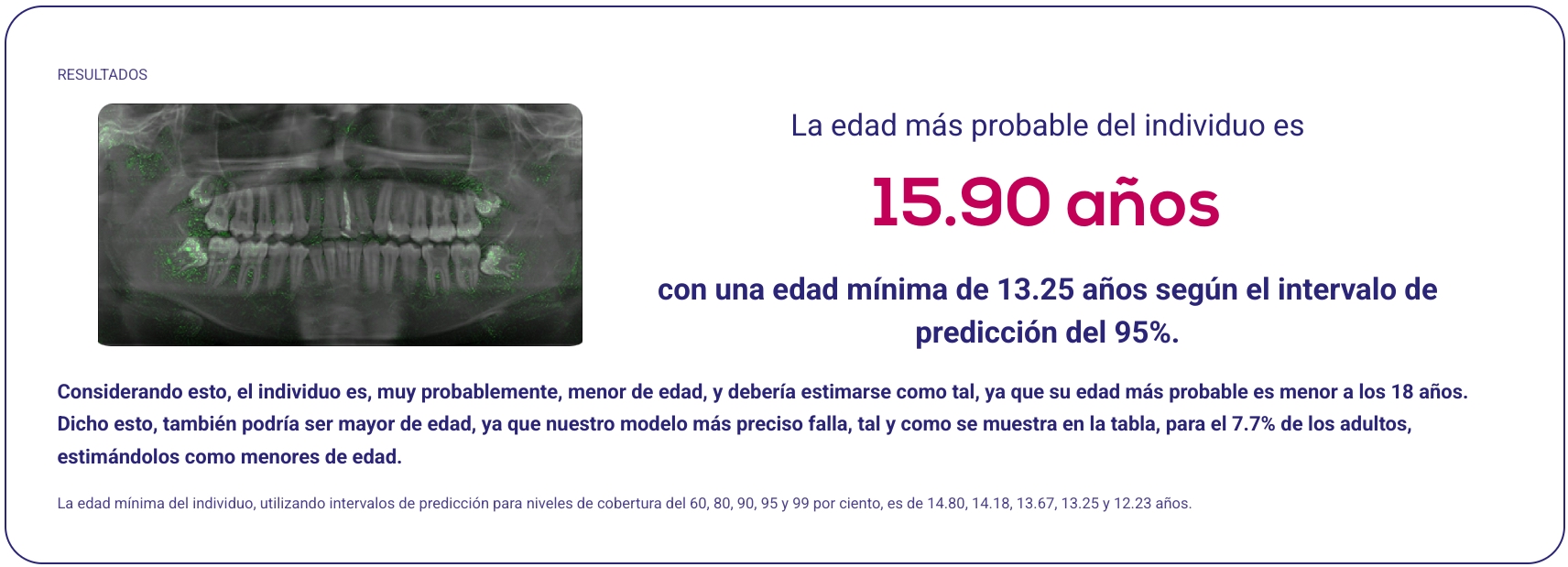
The results show performance comparable to that of forensic specialists, with an average error of just 1.12 years. However, the system’s most significant contribution lies not only in its accuracy but also in its ethical approach. LAENet incorporates uncertainty estimation techniques that allow for the calculation of prediction intervals and, consequently, a statistically supported minimum estimated age. This mechanism drastically reduces the risk of misclassifying a minor as an adult, an error with serious legal and social consequences. Furthermore, the model provides activation maps that show which regions of the X-ray were relevant to the decision, reinforcing transparency and human oversight.
The study underscores that legal age estimation is a complex process that traditionally relies on manual methods, which are slow and subject to inter-observer variability. The proposal developed by DaSCI and Panacea offers an objective, reproducible, and validated alternative across diverse populations, aligned with European principles of Trustworthy Artificial Intelligence, particularly regarding technical robustness, non-discrimination, and social welfare.
As part of their commitment to knowledge transfer, the team has made a free application available to healthcare and forensic professionals, allowing them to easily use the system. Through this application, users can upload an orthopantomogram and obtain age estimates, prediction intervals, and visualization of the model’s areas of interest. The tool can be accessed at this link.
This advance represents a decisive step towards the real application of artificial intelligence in contexts of high social sensitivity, where scientific precision and the protection of human rights must always go hand in hand.
The Andalusian Interuniversity Institute for Data Science and Computational Intelligence – DaSCI Institute – is a collaborative entity between the Universities of Granada, Jaén, and Córdoba dedicated to advanced research and training in the field of Artificial Intelligence, with a particular focus on Data Science and Computational Intelligence. The institute brings together a distinguished group of researchers who work on joint projects, promoting the development and application of innovative technologies across various sectors. With the aim of becoming a leader in its field, DaSCI fosters the transfer of scientific knowledge to the socioeconomic environment, thereby contributing to technological progress and the digitalization of industry.
Panacea Cooperative Research S. Coop., a spin-off from the University of Granada (UGR), is a research cooperative dedicated to R&D and the development of AI-based software for human identification and forensic science. Its best-known product, Skeleton-ID, is already used in numerous cases by forensic institutions in Spain and abroad. Working closely with the University of Granada, Panacea focuses its efforts on creating products with a high social impact in the forensic field, as well as promoting technology transfer to bring research results to the socioeconomic fabric.
Link to the publication:
https://www.sciencedirect.com/science/article/pii/S1568494625016990
Link to the tool:
Contact: Javier Venema – javiervenema.panacea@gmail.com