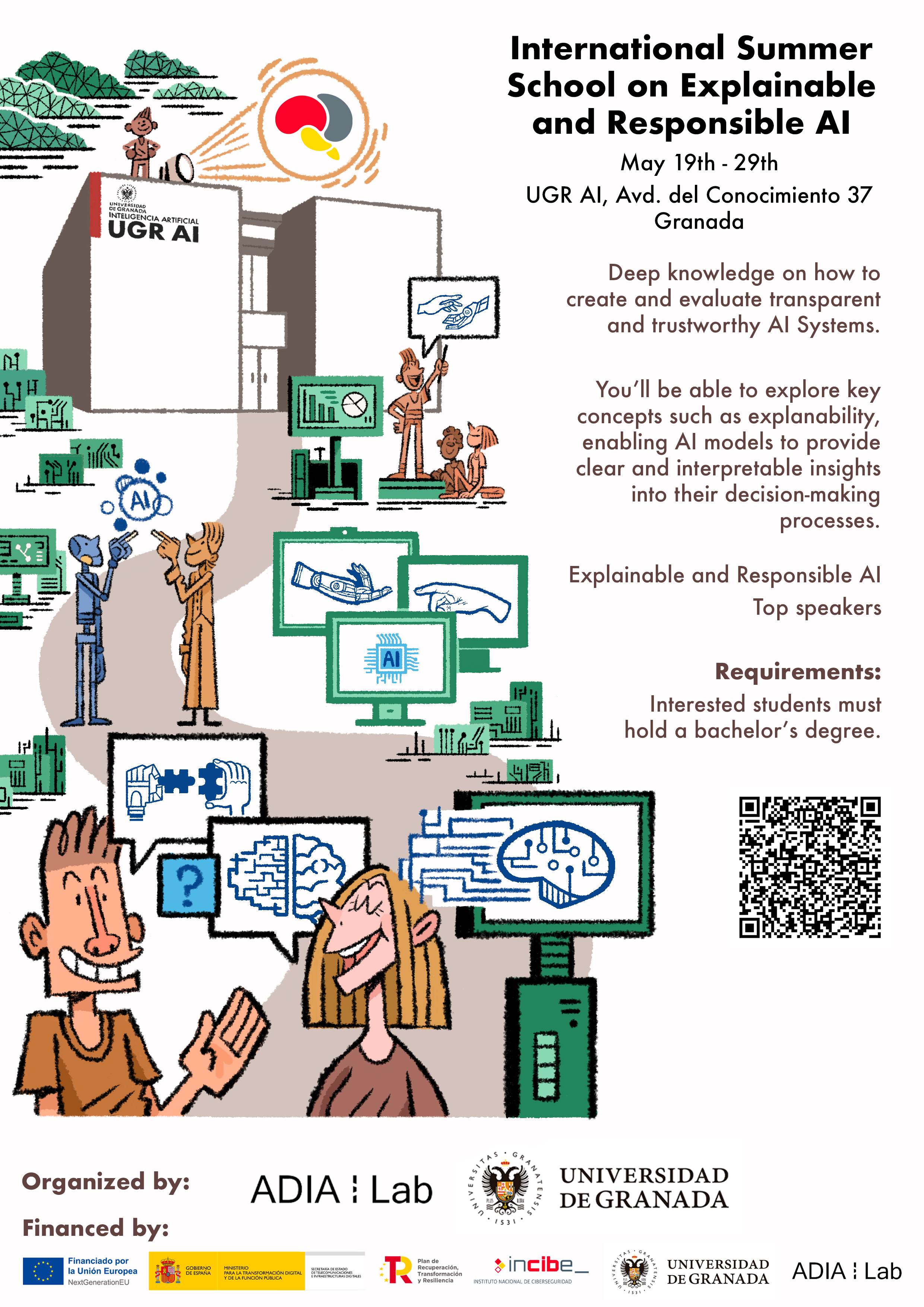
- International summer school celebrates its second edition with more than 150 applicants
- More than fifty predoctoral researchers from all over the world attend the international summer school where some of today’s most outstanding researchers give lectures.
The city of Granada welcomes experts and students from all over the world at the International Summer School organised by ADIA Lab and the University of Granada on the theme Explainable and Responsible AI. The summer school is part of the IAFER-Cib Strategic Project “Ethical, Responsible and General Purpose Artificial Intelligence for Cybersecurity” funded by the National Cybersecurity Institute (INCIBE), an entity under the Ministry for Digital Transformation and Public Function through the Secretary of State for Telecommunications and Digital Infrastructures, and the University of Granada. The course was inaugurated by David de Francisco Marcos, Deputy Director General for the Promotion and Regulation of Artificial Intelligence, Enrique Herrera, Vice Rector for Research and Transfer at the University of Granada, Francisco Herrera, Director of DaSCI, professor at the UGR and PI of the INCIBE project in which this conference is framed, Abdulla AlKetbi, President of the ADIA Lab Operations Council, and Amelie Koch, Senior Scientist and Chief of Staff at ADIA Lab.
This summer school is part of the Strategic Project “Ethical, responsible and general purpose artificial intelligence for cybersecurity” IAFER-Cib (C074/23), as a result of the collaboration agreement signed between the National Institute of Cybersecurity (INCIBE) and the University of Granada. This initiative is carried out within the framework of the funds of the Recovery, Transformation and Resilience Plan, financed by the European Union-Next Generation EU.

The summer school, which will be held until May 29, will address the challenges and opportunities in the field of explainable and responsible AI, an area that has gained great relevance in recent years. The interest in the subject matter is reflected in the more than 150 applications received for this second edition of the International Summer School. The great reception of this second edition confirms the impact and the solid reception already reaped by the first edition in 2024.
The lectures will be held at the UGR IA building located in the Granada Health Technology Park, which is also the headquarters of the Andalusian Interuniversity Institute in Data Science and Computational Intelligence and the AI Granada Foundation. The summer school is attended by more than 50 students from all over the world (19 from the United Arab Emirates, 9 from the University of Granada, 8 from the rest of Spain and the rest from places as diverse as the USA, France, Italy, Norway and Denmark).
Program and Objectives
The summer school program will include keynote lectures, hands-on workshops and networking sessions, featuring leading researchers and industry practitioners. Attendees will have the opportunity to explore topics such as trust and safety principles of AI, the role of explainable AI, agent-based models, visualization of human-centric XAI models, complexity, sustainability and causality of AI, regulation in AI, automatic driving among others.
Speakers include Francisco Herrera, Director of DaSCI and professor at the University of Granada, Miguel Hernán, director of CAUSALab and professor at Harvard University, David Fernández-Llorca, scientist at the European Commission, José Roberto Morán, from the University of Oxford, Natalia Díaz, professor at the University of Granada, Juan Carlos Trujillo from the University of Alicante, Bastian Bergman, Florian Krach and Josef Teichmann from ETH Zurich, Alicia Troncoso from the University Pablo de Olavide, Joao Manuel Portela from the University of Porto, Roberto Confalonieri from the University of Padua, Luis Seco, from the University of Toronto, Menna El-Assady from ETH Zurich…. among others.

The industrial sector will also be present with representatives from Minsait, Google, Repsol and Crunch Lab.
UGR and Granada, AI epicenter this summer
David de Francisco Marcos, Deputy Director General for the Promotion and Regulation of Artificial Intelligence, pointed out that “explainability is a central issue in the research and development of safe and reliable AI, focused on human beings, and is fully in line with all the activity being carried out by the Artificial Intelligence Department in terms of regulation and safe adoption of this technology”.
“This Summer School is an important initiative to fosterinternational AI research and collaboration. As AI systems increasingly impact critical aspects of our lives, ensuring their trustworthiness and safety is essential.. This program brings together experts from around the world to explore the ethical, technical and social dimensions of AI, equipping participants with the knowledge and tools to develop responsible AI technologies that benefit society and advance research” said Dr Horst Simon, Director of ADIA Lab.
Francisco Herrera said: “Granada becomes the epicenter of AI this summer, and we are proud to host once again such a relevant and necessary event in the current context. The course is part of a broader project that involves research, collaboration, transfer and of course training”.
“We are very happy with the celebration of this new edition of the summer school but also because this week we are going to sign the agreement to install ADIA Lab in Granada in one of the offices of the Gran Via 48 building of the University of Granada, as the first ADIA Lab headquarters in Spain” says Enrique Herrera, vice-rector for research and transfer of the University of Granada.
This summer school is part of the Strategic Project “Ethical, responsible and general purpose artificial intelligence for cybersecurity” IAFER-Cib (C074/23), as a result of the collaboration agreement signed between the National Institute of Cybersecurity (INCIBE) and the University of Granada. This initiative is carried out within the framework of the funds of the Recovery, Transformation and Resilience Plan, financed by the European Union-Next Generation EU.
INCIBE’s particular mission is to boost the cybersecurity capabilities of society and the economy in general through a programme that seeks to promote and generate knowledge and its transfer to the productive sector, especially by establishing synergies between the social and economic spheres of cybersecurity. To develop this purpose, the programme of grants for the excellence of advanced research teams in cybersecurity was launched in 2018. In 2022, specifically on 5 December, in order to give continuity to this strategy, the public invitation for collaboration in the promotion of Strategic Cybersecurity Projects in Spain was published.
These initiatives are part of the Global Security Innovation Programme, included in the Recovery, Transformation and Resilience Plan (PRTR) through Component 15. Investment 7 Cybersecurity: Strengthening the capacities of citizens, SMEs and professionals and boosting the sector.
Strategic projects are a way of providing concrete solutions to some of the greatest scientific and technological challenges facing our society and economy. They are designed to promote the application of the results of research and innovation, combining new forms of governance and collaboration, as well as involving citizens and the productive and social fabric.
About DaSCI-UGR
The Andalusian Inter-University Institute in Data Science and Computational Intelligence, known as DaSCI Institute, is a collaborative entity between the universities of Granada, Jaén and Córdoba. It is dedicated to advanced research and training in the field of Artificial Intelligence, with a particular focus on Data Science and Computational Intelligence. The institute brings together an outstanding group of researchers working on joint projects, promoting the development and application of innovative technologies in various sectors. With the aim of becoming a benchmark in its field, the DaSCI promotes the transfer of scientific knowledge to the socio-economic environment, thus contributing to technological progress and the digitisation of industry. https://dasci.es/es/
About INCIBE
The National Cybersecurity Institute is an entity dependent on the Ministry for Digital Transformation and Public Function through the Secretary of State for Telecommunications and Digital Infrastructures, consolidated as a reference entity for the development of cybersecurity and digital confidence of citizens and companies. It is also a driver of social transformation and an opportunity for innovation, fostering R&D&I and talent.

Resources and links:
- Complete Summer School Program – https://www.adialab.ae/summerschool-2025-xai