menteScopín, the conversational agent designed to accompany, inform, and guide young people on key mental health issues, is now available. It is a proof of concept accessible from the Mentescopia website, developed as part of the menteScopia project.

MenteScopín was created by a multidisciplinary team from the Andalusian Interuniversity Institute for Data Science and Computational Intelligence (DaSCI) at the University of Granada (UGR), with clinical advice from the Virgen del Rocío University Hospital and the Institute of Biomedicine of Seville (IBiS).
The technical development was carried out by Pablo Galán Delgado, a student on the Master’s Degree in Data Science and Artificial Intelligence, under the supervision of Dr Rocío Romero Zaliz, a researcher at DaSCI, and with the advice of professionals from the Virgen del Rocío Hospital and IBiS: Benedicto Crespo Facorro, Nathalia Garrido Torres, Idalino Rocha González and José Manuel Barroso.
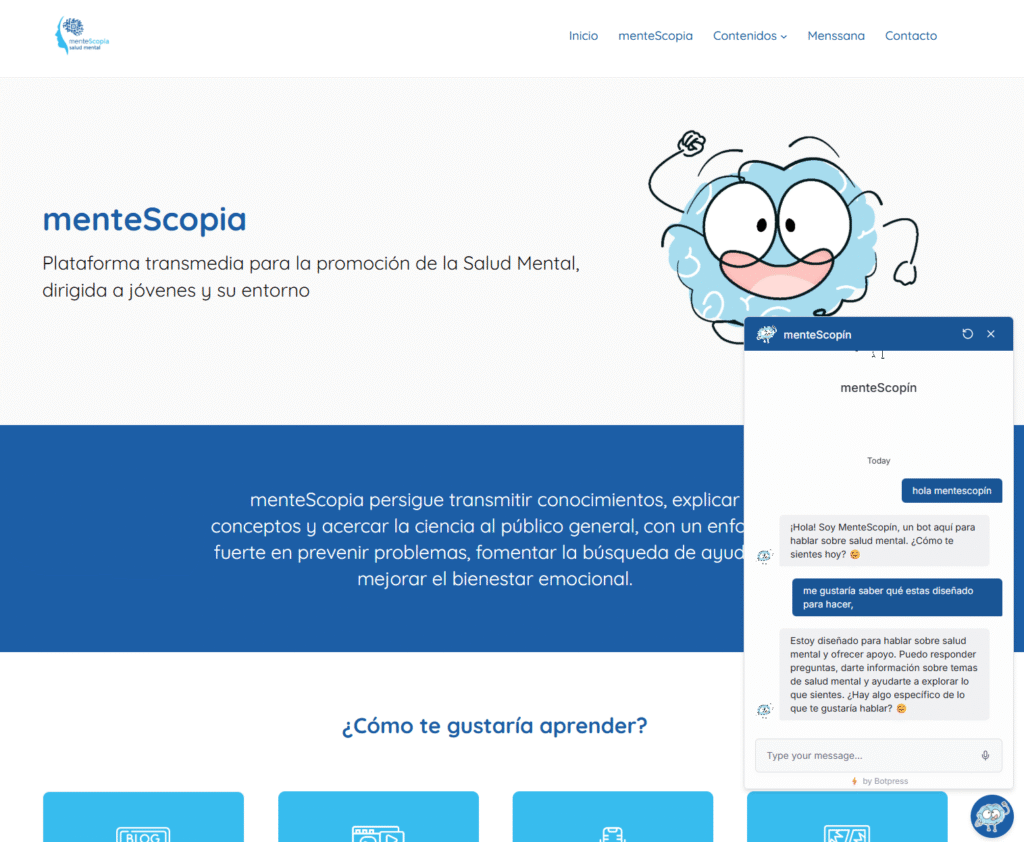
What is a conversational agent?
A conversational agent is an artificial intelligence-based technology designed to interact with people using natural language, either through text or voice. Its goal is to simulate a human conversation in a fluid and useful way, allowing it to answer questions, offer assistance, or simply engage in conversation.
To achieve this, these systems use language models trained with large volumes of text. In the case of menteScopín, the content comes from the last four years of the menteScopia project: texts, interviews, videos, podcasts, and informational materials. The model has been specifically adjusted to hold empathetic conversations and provide reliable information about youth mental health.
Privacy, limits and responsibility
Although menteScopín is constantly evolving thanks to feedback from psychologists and psychiatrists, it is important to note that:
- It does not store users’ personal data.
- It does not link conversations to IP addresses or locations.
- It does not have the ability to contact emergency services.
It is an informative and supportive tool, not a substitute for mental health professionals. If it detects keywords or ideas related to emotional distress, the agent offers useful resources: helplines, recommended reading, videos and links to specialised services.
The agent is constantly evolving thanks to a process of continuous improvement based on feedback from psychologists and psychiatrists. This clinical team analyses the system’s responses and proposes adjustments to ensure its accuracy, sensitivity and suitability for young audiences.
The aim is for this first version to give way to a more advanced conversational agent, developed locally, with greater privacy, greater interaction capacity and without dependence on paid services. In the medium term, it is expected to be integrated into clinical, educational and scientific dissemination environments.
menteScopín is part of menteScopia, a transmedia platform promoted by the Translational Psychiatry group (PsyNal), with the support of the Spanish Foundation for Science and Technology (FECYT) aimed at promoting mental health among young people and their environment.
More information in: https://mentescopia.psynal.eu